
The short version: PhotoPills is the bigger toolkit, with a large set of photography calculators, Night AR and a Find tool that searches dates for an alignment. LightPlan is built to show you the shot before you go. It plans on real 3D terrain and buildings, puts you at eye level where you'll stand with your lens, and has clouds, rain and the best Milky Way nights in the same app.
Should you switch from PhotoPills?
PhotoPills is a deep app, and it has earned its reputation. It has a big set of photography calculators, a Night AR that overlays the celestial poles, star trail rotation and meteor shower radiants, and a Find tool that searches dates for an alignment from numbers you enter. If that's how you work, LightPlan doesn't replace them. Its limits show up when you want to see the shot rather than work it out.
Seeing the shot
PhotoPills plans with azimuths and elevation angles on a 2D map, and buildings aren't counted in those angles. LightPlan plans on real 3D terrain and buildings, and Observer View (Pro) puts you at eye level where you'll stand, with a 14–600 mm lens. For planning a composition, it's the biggest difference between the two.
Learning it
Reviewers describe a steep learning curve with PhotoPills, which comes with doing so much. LightPlan does less, and your first plan takes three steps on one screen.
Weather and the Milky Way
LightPlan shows cloud cover and rain forecasts about five days ahead on its 2D maps (Pro). PhotoPills doesn't list forecasts. For the Milky Way, PhotoPills has visibility and quality panels, while LightPlan scores each night on darkness, core height and moonlight, and ranks the next 30 at your spot (the full list is Pro).
Sharing and the Mac
PhotoPills shares a KMZ file for other PhotoPills users, or an image. A LightPlan plan link opens in the app, or on a 3D map on the web for a client or friend without it. LightPlan also runs as a native Mac app, with your saved locations synced from iPhone and iPad. PhotoPills has no Mac app.
The verdict
Stay with PhotoPills if
- You rely on its calculators for exposure, depth of field or star trails.
- You use Night AR.
- You want an app to search dates for an alignment.
Move to LightPlan if
- You want to see the frame before you go.
- Buildings or terrain are part of your shot.
- You want the forecast in the same app, or you plan on a Mac.
The two also work side by side: keep PhotoPills for its calculators, and plan the shot itself in LightPlan. The fairest test is a shot you know well. Plan it in both, and see which tells you more.
Easy from the first minute
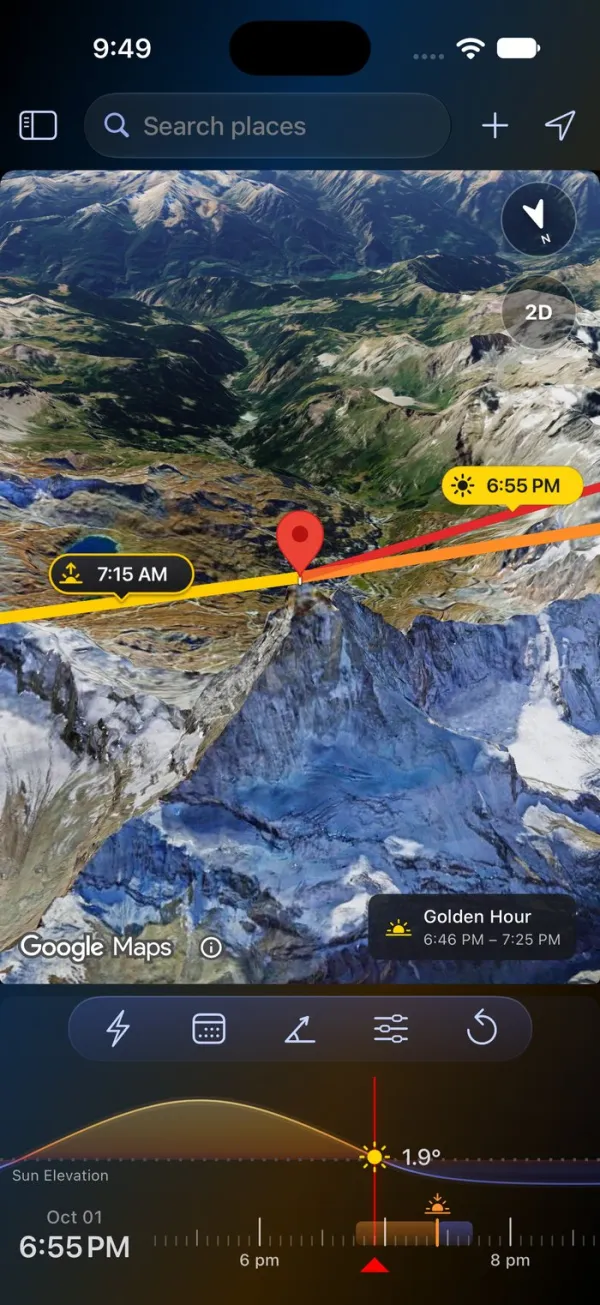
LightPlan is built so you can plan a shot without a tutorial. Your first plan takes three steps:
- Put the marker on your subject. Search for a place, or tap the map.
- Pick the day and time. Tap Date, then drag the timeline to the hour.
- Read the light. The lines point to the sun and moon, and a chip on the map says when it's golden or blue hour.
There are no panels to decode before you start. Times are always in the place's own time zone, the timeline is coloured like the light, and Product Tour replays the tips on the real controls whenever you want a refresher.
PhotoPills is famously powerful and famously hard to learn: reviewers point to its steep learning curve, and its planner spreads the answer across a series of numbered panels you swipe through.
The same shot: a crescent moon through the Palace of Fine Arts
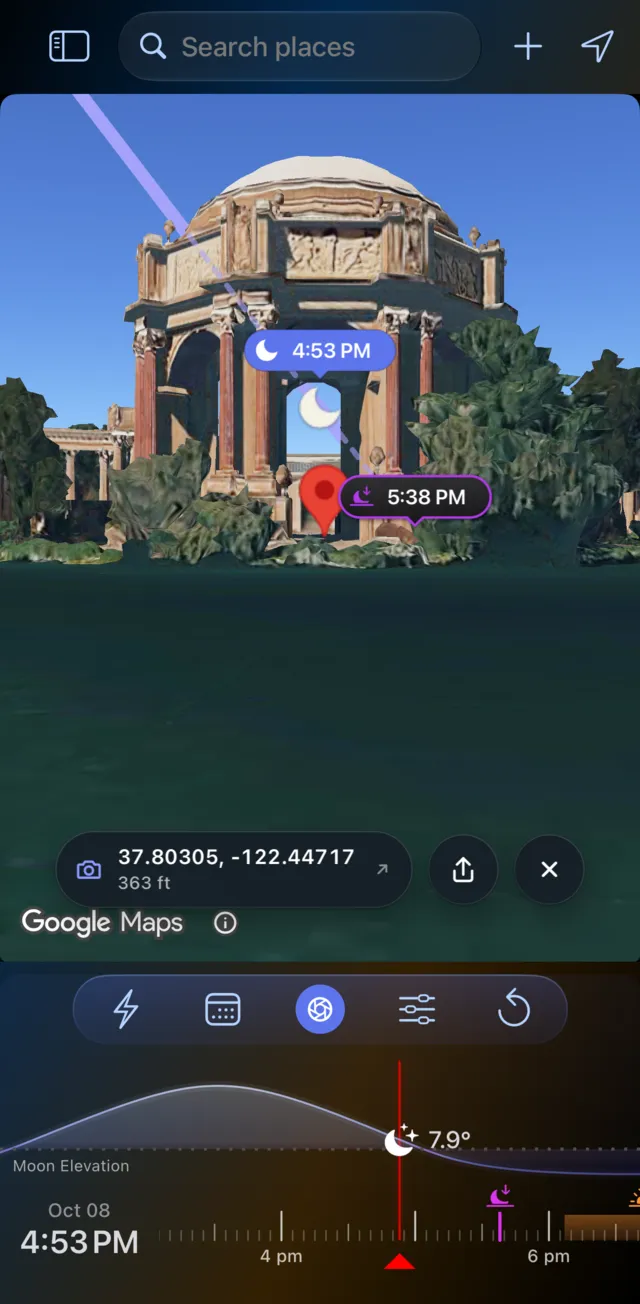
You want a thin crescent moon framed in the rotunda of San Francisco's Palace of Fine Arts, from the path across the lagoon. Here's the plan in each app.
In LightPlan: see it
- Put the red marker on the rotunda, switch to Photorealistic 3D, tap the eye, and tap where you'll stand.
- Set Track to Moon, step through the dates and drag the timeline: the moon moves across the real columns and dome until it sits in the arch.
- Set the Lens to your focal length to check what fits, then send the plan as a link.
In PhotoPills: work it out
- Put the Red Pin where you'll stand and the Black Pin on the rotunda, and read the azimuth and elevation angle in Panel 2.
- Run Find for the moon at that azimuth and elevation over a date range, then sort the table of results.
- Open each candidate on the 2D map and picture how it will look; its guide notes the elevation angle doesn't account for a building's height.
We checked this plan with an independent ephemeris: at 4:53 PM on 8 October 2026 the moon is 7.9° above the horizon at an azimuth of 263°, a 3% crescent, lining up with the rotunda, which lies at 257° from where you stand.
With PhotoPills you get numbers and imagine the picture. With LightPlan you see the picture: the columns, the dome, the moon and how much of it your lens will hold. That's the difference between hoping a shot works and knowing it does before you leave home.
The Milky Way, scored night by night
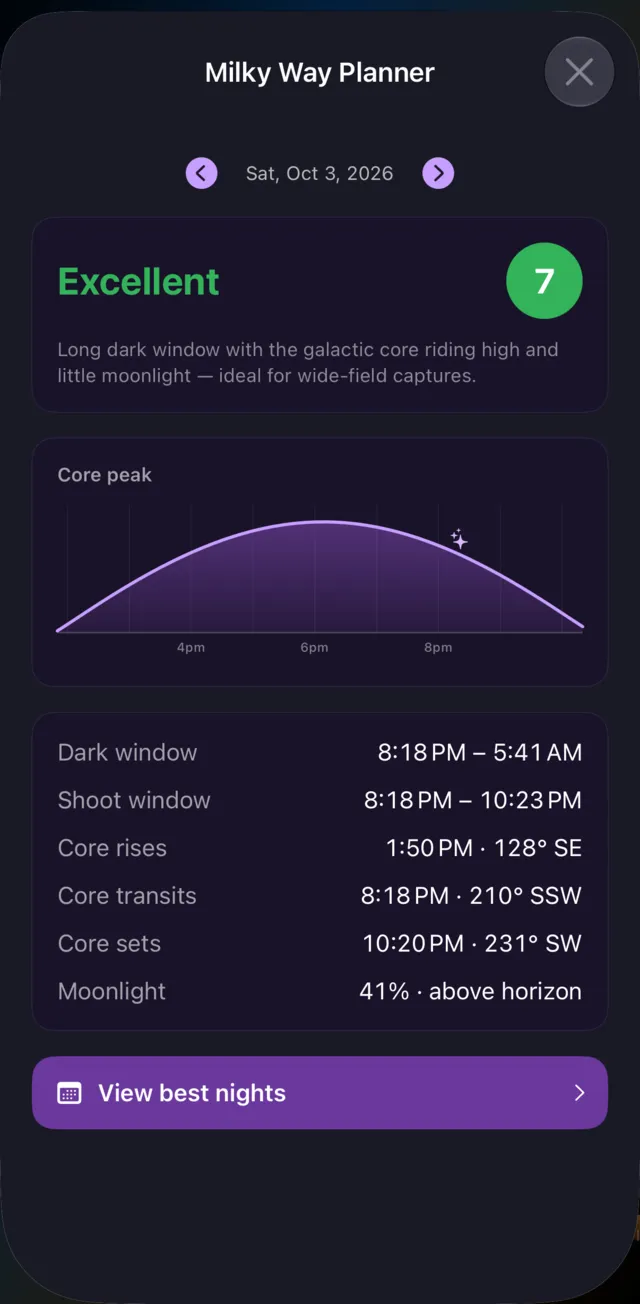
A great Milky Way night needs three things at once: real darkness, the galactic core above the horizon, and the moon out of the way. LightPlan's planner finds where they overlap and tells you, in plain numbers:
- Dark window: when the sun is at least 18° below the horizon.
- Shoot window: dark, with the core up, and with the moon down if it's half lit or more.
- The core: when it rises, peaks and sets, and which way to face.
- A score from how long it's dark, how high the core climbs and how little moonlight there is.
Best Milky Way Nights ranks the next 30 nights at your location (the top 3 are free), and an alert can warn you one to three days before a great night at any saved spot. PhotoPills shows Milky Way visibility and quality for the date you pick, in its panels.
AR on the real sky, free
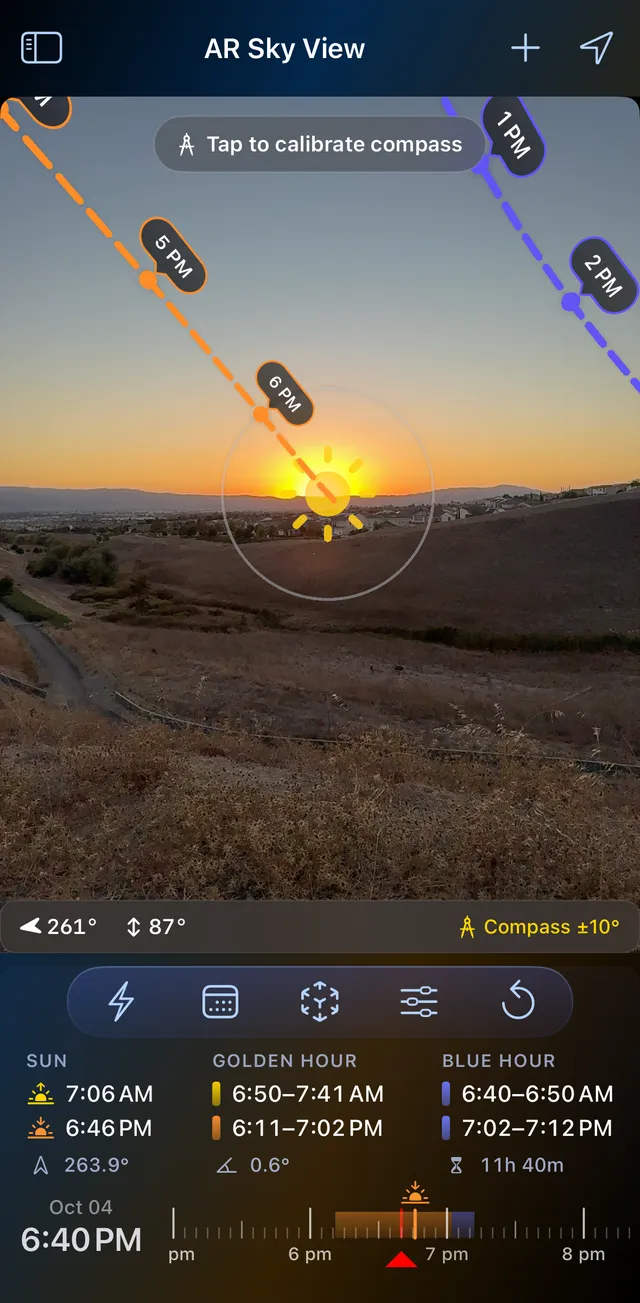
On location, hold up your phone: the sun's path is drawn across the real sky with a time at every hour, the moon's in blue, and the day's sunrise, sunset, golden hour and blue hour sit underneath for exactly where you're standing.
- Calibrate against the real sun or moon in the crosshair when the compass drifts.
- Drag the timeline to see any other hour.
- With Pro, the Milky Way core's path across tonight's sky.
AR Sky View is free in LightPlan on iPhone, iPad and Android. Golden and blue hour use the same sun angles as PhotoPills (+6° to −4°, then −4° to −6°), so the times you're used to carry straight over.
Share the plan with anyone
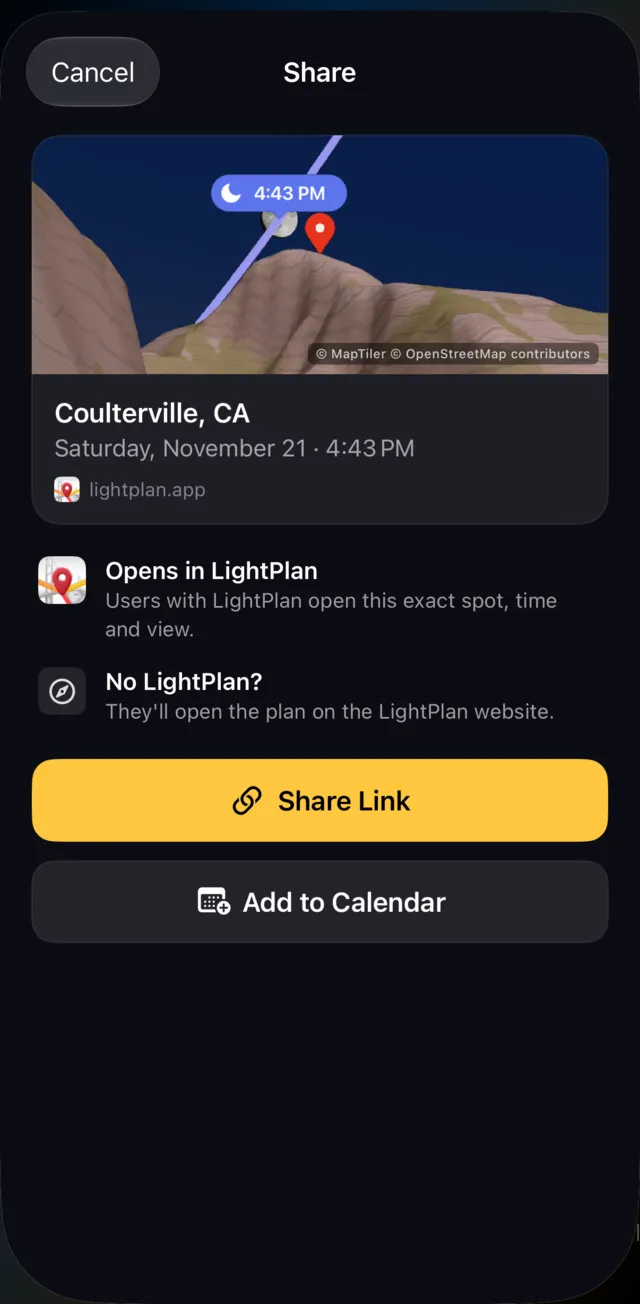
A shoot usually involves someone else: a second shooter, a client, a model, a friend driving out with you. In LightPlan, Share Link turns the exact place, time and view into one short link.
- They have LightPlan: it opens at the same spot, time and camera angle, or straight into Observer View.
- They don't: they see the plan on the web on a 3D map, with the day's light windows and directions. Nothing to install.
- Add to Calendar: the shoot time, or the day's golden and blue hours.
Sharing is free. PhotoPills shares plans as KMZ files to open in PhotoPills, or as an image.
Shadow Map: see where the light falls
Drag the timeline and every building, tree and hillside casts its real shadow at that moment. Here is San Francisco City Hall on the same day, six and a half hours apart:
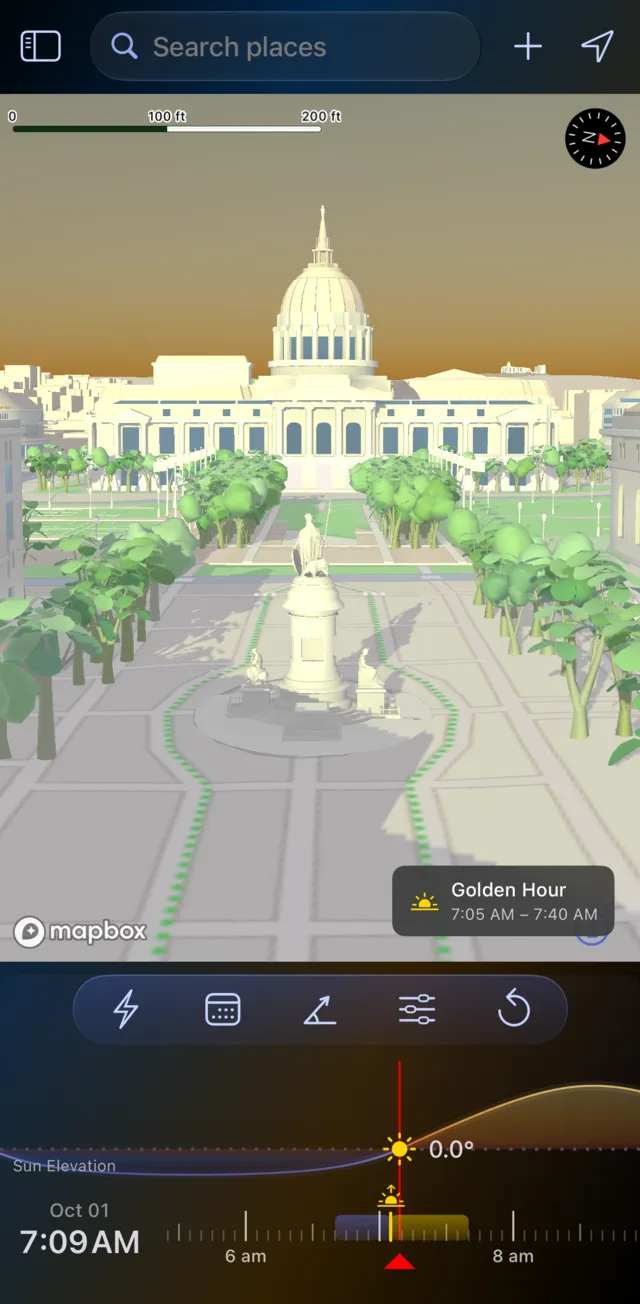
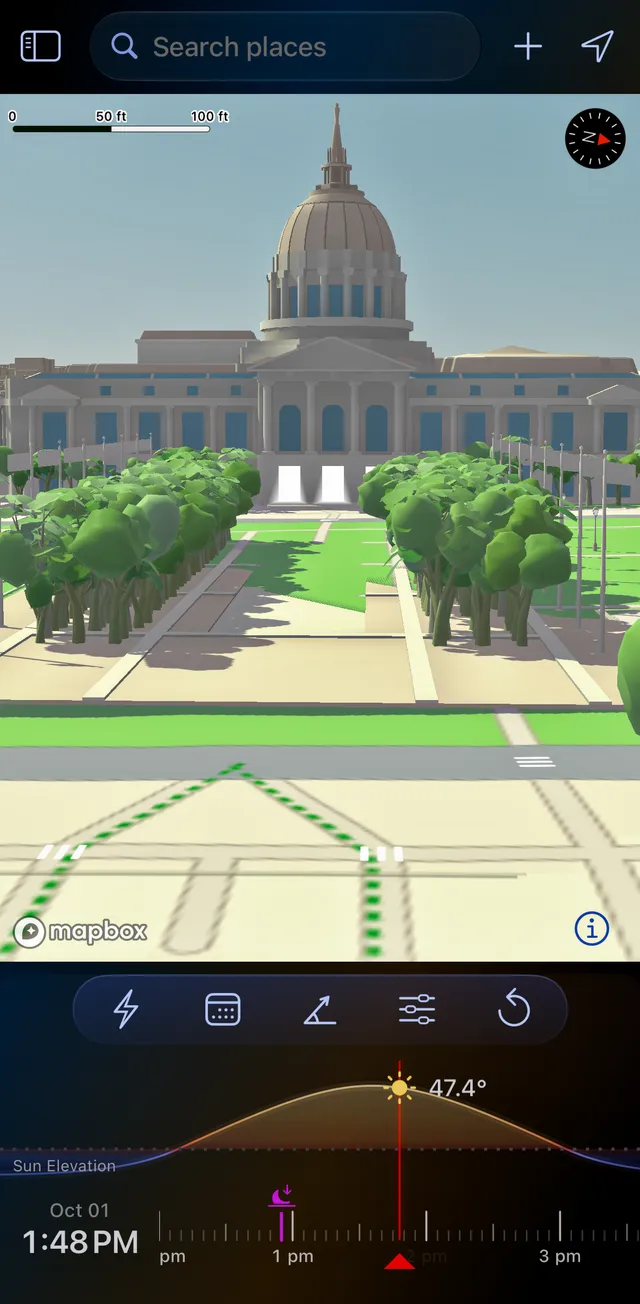
San Francisco City Hall, 1 October 2026.
- Find open shade for a portrait session, or the hour a facade is evenly lit with no hard shadows across it.
- Measure a shadow. A shadow object at the marker stands in for a person, a tree or a building; set its height and width, and LightPlan shows its Shadow Length and Shadow Ratio. At 1:48 PM here, a 6 ft person casts a shadow about 5.5 ft long.
- On iPhone Duo: Opened out and turned sideways, Split View shows the Shadow Map beside the main map.
- Beyond photography: when a garden, terrace or street gets sun, or where a new building's shadow will fall.
PhotoPills' official guide and FAQs don't list a shadow view; its planning is on a 2D map. Shadow Map is part of LightPlan Pro; open it from Quick Actions or the menu.
More that sets LightPlan apart
- Terrain 3D lit by the hour: mountains glow warm at golden hour and cool at blue hour, with peaks labelled.
- A native Mac app for planning trips on a big screen, with your spots synced from iPhone and iPad through iCloud.
- Alerts before sunrise, sunset, golden hour, the moon and great Milky Way nights, from the moment itself to a day before, and Siri on Apple devices: "When is golden hour in LightPlan".
Feature by feature
| LightPlan 3.0 | PhotoPills | |
|---|---|---|
| Ease of use | First plan in three steps, on one screen | Steep learning curve, per reviewers |
| Price | Free; Pro $2.99/month or $19.99/year, with a free trial | $10.99 one-time, per platform |
| Platforms | iPhone (incl. iPhone Duo), iPad, Mac, Android | iPhone, iPad, Apple Vision, Android |
| Planning map | Photorealistic 3D, Terrain 3D, Satellite 2D, Terrain 2D | 2D map |
| Buildings in the plan | Yes — Photorealistic 3D | Not counted in elevation angles |
| Eye-level view from your spot | Yes — Observer View, 14–600 mm (Pro) | Not listed |
| Cloud and rain forecasts | Yes — on the map (Pro) | Not listed |
| Milky Way nights scored and ranked | Yes — 30-night ranking | Visibility and quality panels |
| Shadows from buildings and terrain | Yes — Shadow Map (Pro) | Not listed |
| AR view | Yes — AR Sky View, free | Yes — AR and Night AR |
| Plan links anyone can open on the web | Yes | KMZ file, or an image |
| Mac app | Yes | No |
| Golden / blue hour angles | +6° to −4° / −4° to −6° | +6° to −4° / −4° to −6° |
| Eclipses | In the Moon Calendar | Yes — panels and path maps |
| Alerts | Sunrise and sunset free; every event with Pro | Exposure timer; calendar alerts for plans |
| Widgets | Pro, with a 14-day free trial | Yes |
| Automatic alignment date search | No | Yes — Find |
| Photography calculators | No | Yes |
Based on each app's website and store listings as of 14 October 2026; prices are US prices. Apps change, so check the current listing before you buy. "PhotoPills" is a trademark of its owner; LightPlan is independent and not affiliated with, endorsed by or sponsored by it.
When PhotoPills still makes sense
To be fair to a good app: if you rely on photography calculators (exposure and ND, depth of field, hyperfocal, star trails, time lapse), PhotoPills has a big set and LightPlan has none. Its Night AR also overlays the celestial poles, star trail rotation and meteor shower radiants, and its Find tool searches dates for an alignment from numbers you enter. Some photographers keep PhotoPills for those and plan the shot itself in LightPlan.
Bringing your spots across
LightPlan's search takes coordinates as well as place names, so you can move a saved spot by copying its coordinates and pasting them in. Both forms work: decimal degrees (37.80305, -122.44717, with minus for south and west) or degrees, minutes and seconds with N, S, E or W. Tap + to save it, name it and pick a folder. Each saved location keeps its view and, for Observer View, where you'll stand.
Two things that surprise people in their first week:
- Times are always local to the place, not to you. Plan an Icelandic sunrise from home and you see Iceland's clock time, as you'll live it there.
- A minute's difference from another app is normal. Apps treat the horizon and the bending of light by the air slightly differently. LightPlan's sun and moon positions are tested against the U.S. Naval Observatory and NASA JPL. If you shoot from high up, raise Marker Distance From Ground in Settings: from a height, the horizon drops, so the sun rises earlier and sets later.
Frequently asked questions
Is there a free alternative to PhotoPills?
Yes. LightPlan is a free PhotoPills alternative for iPhone, iPad, Mac and Android. Its free version plans the sun and moon on Photorealistic 3D and terrain maps, times golden and blue hour, shows the sun's and moon's paths on the real sky in AR Sky View, and includes the Moon Calendar and the Milky Way Planner, for today and the next 2 days, with no account. LightPlan Pro adds any date, Observer View, Shadow Map and cloud and rain forecasts.
Is PhotoPills free?
No. PhotoPills is a one-time purchase of $10.99 on the App Store and on Google Play, and neither store lists a free version. The iOS and Android versions are bought separately; a license doesn't move between platforms. LightPlan is free to download and use on both, and on Mac.
Is PhotoPills worth it?
It depends what you need. If your planning question is where and when the sun, moon or Milky Way will be, and whether the shot will work from where you'll stand, LightPlan answers it free and shows it in 3D. PhotoPills is worth $10.99 mainly if you'll use its photography calculators (exposure, depth of field, hyperfocal, star trails, time lapse) or its Night AR.
What does LightPlan do that PhotoPills doesn't?
LightPlan plans on real 3D maps with Google's buildings and trees and with mountains lit by the hour; puts you at eye level where you'll stand with your focal length in Observer View; draws cloud cover and rain forecasts on the same map; scores every night for the Milky Way and ranks the next 30; shows real shadows from buildings and terrain; runs natively on Mac; and shares plans as links that anyone can open on the web. And it's free to start.
Does LightPlan have augmented reality like PhotoPills?
Yes. AR Sky View, new in LightPlan 3.0, shows the sun's and moon's paths across the real sky with a time at every hour, alongside the day's golden and blue hour, and calibrates against the real sun or moon. It's free on iPhone, iPad and Android, where PhotoPills' AR comes with the $10.99 app.
Does PhotoPills work on Mac?
Not as a Mac app: its App Store listing covers iPhone, iPad and Apple Vision. LightPlan runs natively on Mac from the same App Store listing as iPhone and iPad, with saved locations synced through iCloud.
Can LightPlan find the date of an alignment automatically, like PhotoPills Find?
Not automatically. In LightPlan you step through the dates and drag the timeline while watching the moon or sun move against your subject in 3D, so you see the frame, not just the numbers. PhotoPills' Find returns a table of matching dates from an azimuth and elevation you enter.
Is LightPlan free?
LightPlan is free to use every day with no account. The free version covers today and the next 2 days: sun and moon lines and times, golden and blue hour, Photorealistic 3D, Terrain and 2D maps, AR Sky View, the 3D Compass, the Moon Calendar, the Milky Way Planner with the 3 best nights ahead, 5 saved locations, sunrise and sunset alerts, and plan links. LightPlan Pro ($2.99 a month or $19.99 a year in the US, with a free trial) adds any date, unlimited locations, Observer View, Shadow Map, weather layers, the full Milky Way forecast, every alert and widgets.
Try LightPlan free
Plan the sun and moon on real 3D maps, free on iPhone, iPad, Mac and Android.